
Green Book: A review book by Julie
Updated: Jul 16, 2024
If you are a white person who would like to treat black people as equals in every way — who would like to have a set of association with blacks that are as positive as those that you have with whites — it requires more than a simple commitment to equality. It requires that you change your life...-Malcolm Gladwell
WARNING: This one is a little bit longer than the previous reviews so hold on tight.

Summary: Don Shirley, a black piano player with an extraordinary talent and mind, hires Tony Lip Vallelonga, an Italian-American as his driver and road companion for his tour in the South. The movie is composed of events the duo goes through as they develop a special bond in the road of music, racism, prejudgments, self-identity crisis, friendship and growth.
Chapter 1- The Forestory, Screening and Research

Before:
When I saw the poster of the movie after learning that it brought the Oscar home in 2019 Academy Awards, I thought "Well I guess it is one of those movies I will feel the necessity to watch because it won the ultimate award but actually will never want to watch it with full conscience." Crazy thought, I am aware. The blue tones, the faces of actors, the way sun shined at the time the photo for the poster was taken made me just step back.
While: As we were having a hot summer night in our holiday villa, me and my mango brother were scrolling through Netflix to find something to watch. Then, I abruptly stopped at Green Book; I looked at the scene Netflix put for the movie, checked out its genres; drama, comedy, based on real life and I said "Why don't we watch this one, it won the Best Picture two years ago." Everyone seemed convinced and so off we started. I was very satisfied with the movie when it ended; leaving a sense of peace and lightness inside my heart. I found the story smooth, the characters strong, the acting excellent, the colors beautiful, the messages impactful and the ending cliche but different in a way.
After:
When I sat on my working chair to get started with research for my review, I opened all useful reviews . And as I kept on watching and reading, I was shook by the amount of people criticizing the movie for picking sides in anti-racism, not involving real facts but "symphony of lies"(not my words), not letting the family of Don Shirley be a part of the movie making process... It goes on, believe me it does. I was genuinely confused because I sat with all high reviews and ratings and positive things to write in my mind and now the whole internet was full of counter arguments. I eventually thought this would be even more interesting for my review. In the next chapters, I will try to combine everything.
Chapter 2- The name, the setting, the people, the sides
The Name:
When I finished the movie, I genuinely wondered why did the director choose the name Green Book for a film in which Green Book was only a tiny detail. I could not decide what were the director and writer trying to do with that name; was it a metaphor, was it like naming a song with a one time sang random word that is not even in the chorus? Why was I even thinking this much about this name? And then something occurred to me: The fact that Green Book is only used once actually makes perfect sense because Don Shirley never stays in "negro-friendly" hotels and this of course can be summarized with one and only scene.
The atmosphere:
The setting and atmosphere were my favorite elements in the movie. The cinematographer and director did a great job at creating that 1960s "glamorous" , nostalgic, Sinatra America with a dark and filthy background of racism still unreasonably blurring people's minds. Starting from the night club Tony was working in to the bar Doc sings in at the end; I found every scene effective, on point and entertaining to watch.
The people:
Tony's eating habits were another intriguing part of the movie, I must admit. Kind of reminded me of the way in his every single movie Brad Pitt is eating something because well, just click here. Eating habits define people and I do not need to analyze any further because Tony already clearly states it:
"Whatever You Do, Do It 100%. When You Work, Work. When You Laugh, Laugh. When You Eat, Eat Like It's Your Last Meal."
Speaking of Tony, he is an excellent character portrayal. His actions, the way he talks or really bullshits, the way he loves, the way he protects, drives, smokes cigarettes; they all define him. He is consistent, trustworthy and yet still he learns. He is not a closed shell, he learns about the range of racism, about the way you can be black with being a "negro" and the range of ethnicity. Vigo Mortinson is obviously top-notch in the movie, his performance requires serious acclaim. This character has more meanings so I will delve into him in the following parts.
Don Shirley is a beast himself. As the most sophisticated character in the movie and I guess one of the most sophisticated characters I have ever seen in cinema, he has his face expressions engraved in my mind all thanks to the wonderful actor portraying him, Mahershala Ali. I would call him a representer of the self-identity crisis many people need to go through at severe levels to find their place in the stereotypical common society but he is far more complicated to be called a symbol. I think the most prominent thing about him is his thoughts. The brilliant but hard to bend mind. I will get into this mind bending and personal growth thing soon but for now, I think it should be acknowledged that this man is not just a music prodigy, or a black man trying to find his place in white society or a man who has no sense of his roots or anything else. He is a person and I appreciate all the efforts moviemakers and the actor put in to let me see him that way. Of course, later, we understand from interviews given by his family that his character was not complete.
The sides:
After I read a noteworthy amount of reviews and interviews for the film, I came to the decision that the makers of this movie were not in the middle but they picked sides, in anti-racism. Can there be anything as sides in anti-racism? Well, rephrasing: should the director and writer choose their side of telling a story? It is the common thing to do. However, when one of the most delicate issues in American history is in equation this common method feels old and cliche and most importantly offensive, non-factual and "white". This is why I believe that there are so many criticisms directed at the movie creators for not letting the Shirley family contribute or placing everything around Tony not Doc or giving "the souther you go the more cruel and stupid America becomes " message about racism.
I am not an expert of racism or how it is preferred to be handled but this is how I choose to look at this movie. "Given what, and who they had to work with, they could have made a richer, more nuanced character of him, and the film.” These words belong to Edward Shirley, nephew of Donald Shirley. He made his statement quite clear. His words make me question one thing though: what did the director and writer wanted to do exactly? Knowing that the writer was Vallelonga's son, Nick Vallelonga; I think he knew his father's side from the beginning and director took it. Yet again, the delicacy of the big issue was not taken into consideration as they were looking under microscope, not caring about where the substance came from.
Chapter 3- Story building and color use
This part is where cultural elements return to their seats and cinematic elements take the spotlight.
Story building:
The timeline is chronological, there are no flashbacks to anyone's childhood or past; this creates an easy to follow flowing storyline. The film is separated with stories from Tony and Doc's tour trip; each emphasizing something different about both characters; sometimes the reasons behind Docs's preferences, the love Tony has for his life and wife, the way both characters learn from each other, the way perspectives change etc. It is a fact that when a speaker enters the subject with an anecdote or a simple story the audience is more intrigued, for this reason Green Book entertains you.
NOTE: I think I also need to mention that the opening scene is solely about Tony, not Doc. I believe this is a great foreshadowing for the side we are going to be watching as the film progresses. So it is not Doc's story but it is the reflection of Doc in Tony's eyes. This difference is hidden but crucial in the review of the movie.
Color use:
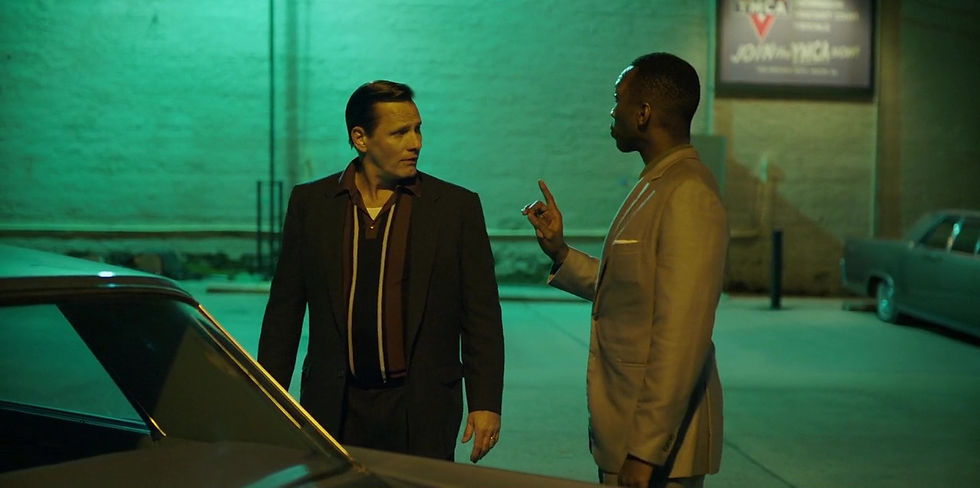
One of the best things about the film is its use of colors. Remember when I mentioned my thoughts about the colors in the movie poster. Now I understand them better. Throughout the movie we have these blue like, nighty and frowning prominent colors with extra spices of sun, yellow and brightness; night fights between the main characters with dim lights, blue car under extreme sunlight etc. Those lights are the movie, the story we are watching between a black musician and his white driver; a friendship and the dark is the Deep South imagined by the director. If you look at it like that, it makes perfect sense. A subtle but nice detail making the movie scenes hard to forget.
Chapter 4- The Growths and counter arguments

I have a saying in my life, kind of a philosophy "Moving is growing." I believe in growth at most unprecedented moments that make us who we are the second after second. Growth is the most important issue in this movie, something to be carefully examined. The visible growth is Tony's awareness on racism and on the black race with its extents. He could be easily defined as a racist in the beginning of the movie. Then he could be named as a highly prejudicial men about black people, assuming that they have their own way of living, separating themselves from the rest of the world which again could be classified under racism. However, as Doc and him got closer his cynical thoughts are washed with an extraordinary person's gift. This makes his softer side more visible and results in a growth.
If I was to talk about Doc's growth, I would enter the danger zone. I think most of the arguments coming from people and critics is based on this issue because when you think you are watching the story of a person, you want to see them grow in ways. Yet Doc's thoughts and lifestyle is not as flexible as Tony's. He is principled and have a way more complex outer shell. Not tougher but more complex. The thing is Doc did not need visible growing or explanation of his past acts, present expectations and future dreams. The society needed that growth and Tony acted as a representer on that. The night Doc plays at a bar, the time he eats chicken nuggets with his bare hands were some of the subtle moments you saw growth, growth of flowers inside a beautiful person. This is how I chose to perceive the movie and I have growns to like it more with this point of view.
Lastword
Well, I need thank to those of you who have actually read this loong review where I experimented with a different method of writing. You can find more links to articles that I have read before writing my review, they can shed some light into the way how the movie found its place among audience.
Green Book may not have deserved that Oscar, or may not have caught the right amount of delicacy for such issue as racism but it followed the path Malcolm Gladwell have advised for equity despite little stumbles here and there. Tony should have listened to Doc when he told him to keep his eyes on the road, eh?
Some recommendations for those who agree with Edward Shirley and love character analysis:


Comments